4.9

Google Star Rating
3,200+
Homes Protected In Central Texas





The Intake Side of a System Most Homeowners Never See.
Schedule Your Roof Consultation
Soffit and intake ventilation is the entry point for cooler outside air into your attic, typically located at the lowest point of the roofline beneath the eaves. Exhaust ventilation at the ridge or roof surface only works correctly when there’s adequate intake to draw from. Installing exhaust vents without addressing intake is one of the most common attic ventilation mistakes, and it leaves the system working against itself.
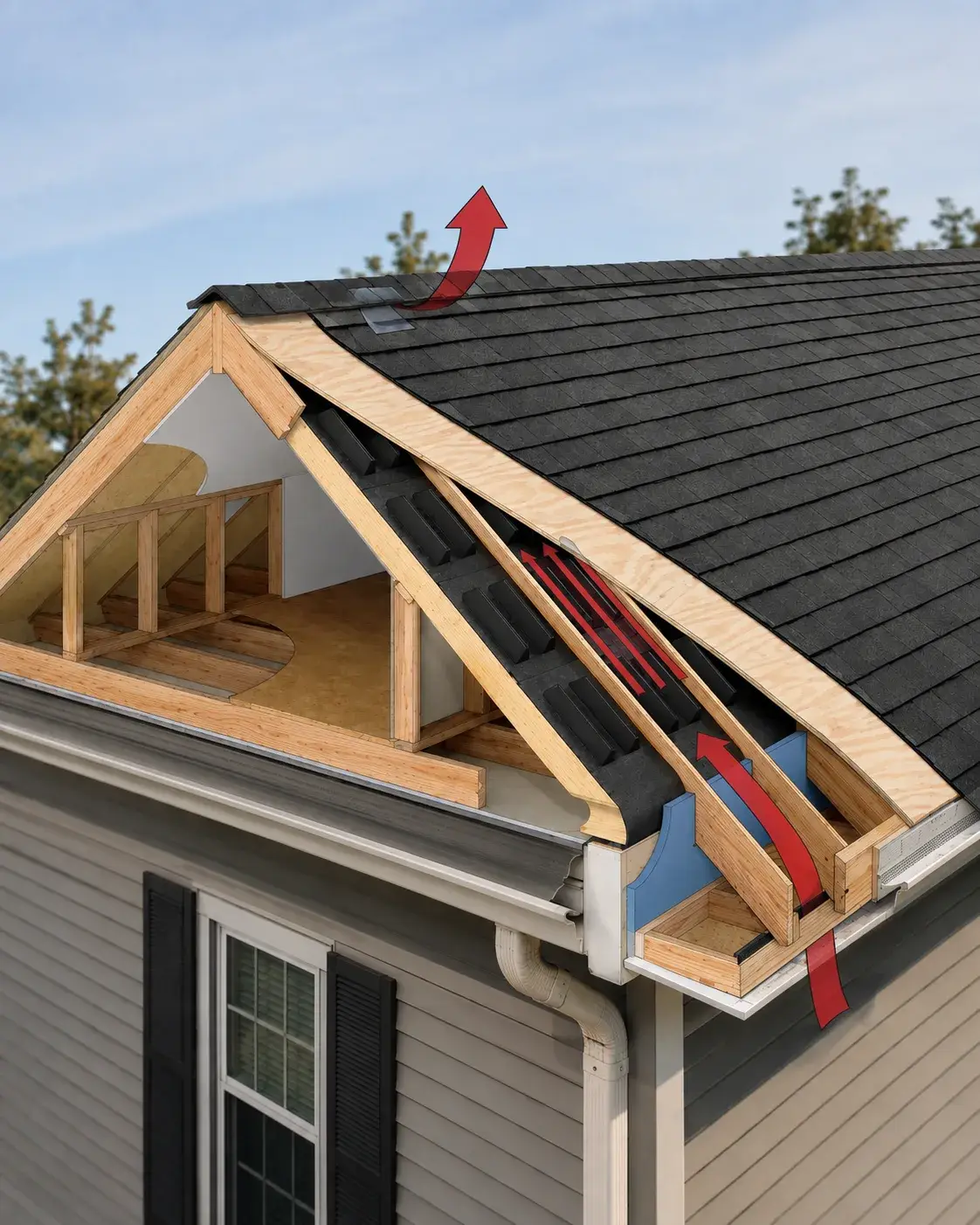
Homeowners notice exhaust components like ridge vents and roof vents because they’re visible from the ground or the attic. Soffit vents are easy to overlook, easy to block with insulation during other home improvements, and easy to underestimate in terms of how much intake area they actually provide relative to exhaust capacity. An imbalanced system, more exhaust than intake or vice versa, doesn’t ventilate correctly regardless of how much money was spent on the exhaust side.
Find out where your system actually stands with an Attic Ventilation Analysis.
A properly balanced ventilation system isn’t just a comfort upgrade. Less heat trapped in the attic means less strain on your HVAC system, fewer compressor cycles, and a unit that isn’t fighting a 160-degree attic all summer. Intake is half of that equation. Exhaust Ventilation covers the other half.
Austin has adopted Wildland-Urban Interface Code requirements that affect ventilation specifications for properties within designated proximity zones to wildland areas, with restrictions on soffit vent installation that vary by zone. These requirements are still being clarified between the City of Austin and roofing manufacturers, and the specifics continue to evolve.
If your property is in or near Austin, we recommend checking your property’s WUI zone using the City of Austin’s interactive lookup tool before any ventilation work begins. And regardless of which contractor you choose, it’s worth asking directly whether their installation process is WUI-compliant for your specific zone.
Check Your WUI ZoneSummer attic temperatures in Central Texas regularly exceed 160 degrees when ventilation isn’t balanced correctly. Adequate intake is the foundation that makes every exhaust component on your roof actually function as designed. Without it, ridge vents, turbine vents, and powered fans are working at a fraction of their intended capacity.
Ark not only replaced my roof, they totally redone my home's exterior. The best-looking work I have ever had done. Nice to have a local Georgetown business right up the road.
The company president is personally committed to excellence from start to finish. He conducted a detailed survey, including an inspection from inside the attic and a drone overview. One of the best experiences we have ever had with a contractor.
Luke and his team were very professional and good at communicating throughout the whole process. They took care of everything and made the work pretty painless. Don't hesitate to give them a chance.